

The “Unfold the Untold” Project
Freeman, N., Snell, L. & Grimwood, T. (2025) An evaluation of Unfold the Untold. Commissioned by Healing Arts Cumbria.
Executive Summary
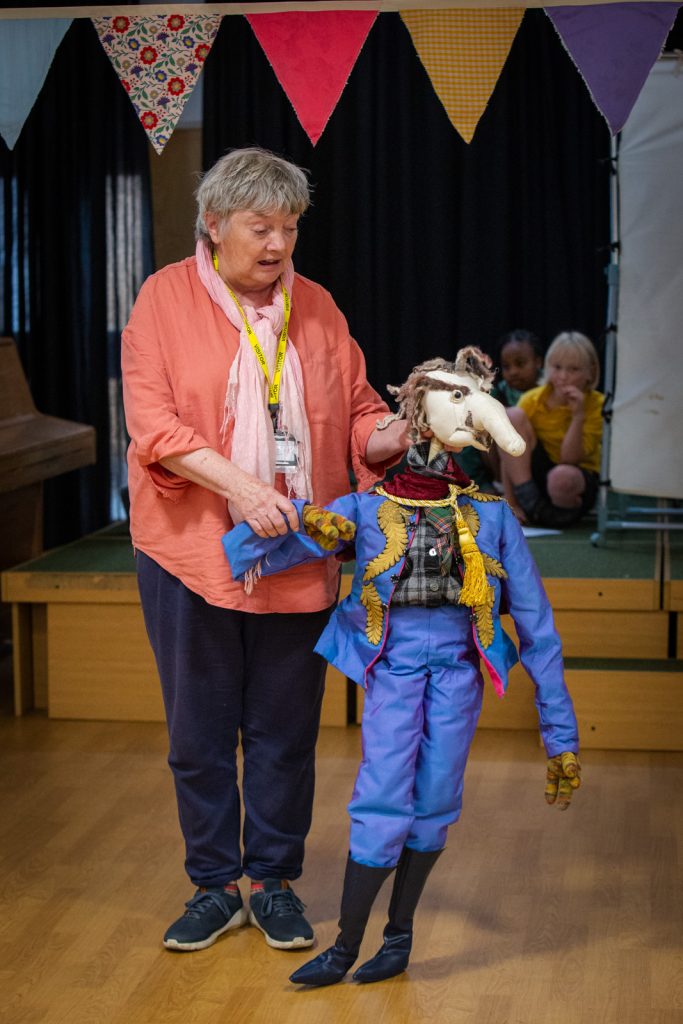
Designed and led by the Healing Art’s artists, the Unfold the Untold project aimed to enhance wellbeing by bringing together patients and staff at Cumberland Infirmary as well as children from a local primary school, through shared storytelling and creativity. The project delivered weekly sessions of “creative conversations” woven in with puppetry, poetry and crafts, and culminated with tea parties, handmade board games, a book that captured participants’ stories called The Major and the Puzzle of the Broken Universe, and shadow puppetry performances of the book.
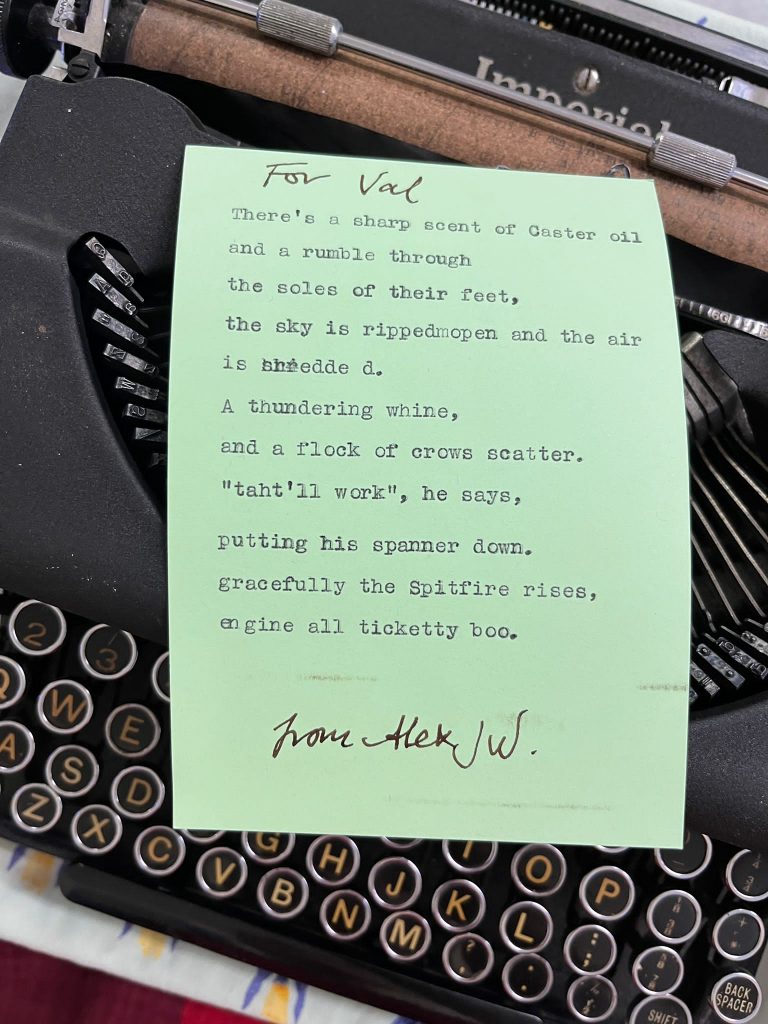
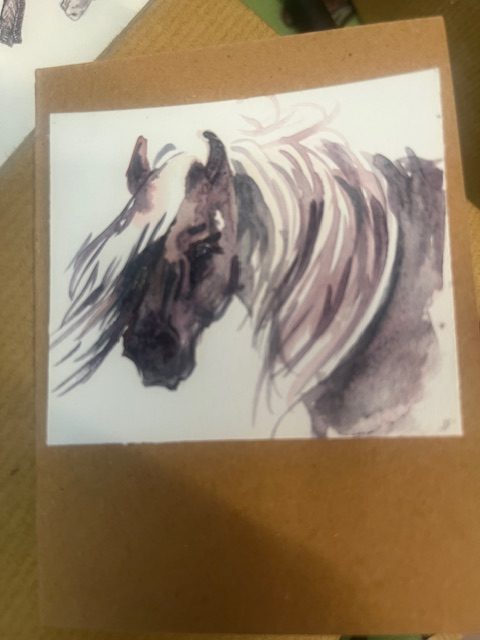
During the creative conversations, practitioners would respond to topics that interested the patients through a range of media such as poetry, drawing and craft. For example, a poem or a drawing would be created in response to a patient’s story about a loved one or a pet and would then be given to the patient as a keepsake. Conversations did not lead to any creative output when the practitioners sensed it wasn’t appropriate. Conversations were also initiated by sending messages between patients and school children on heart-shaped cards that were wound with wool. Others were about writing “recipes for a good life”, or they naturally progressed by the presence of a puppet called “The Major”.
Findings
Findings are grouped into two sections to respond to the aims of the Unfold the Untold service evaluation, which were to understand how activities may work:
1) to contribute to improved patient wellbeing
2) with ward staff and within the ward environment
Unfold the Untold Activities
An overarching perception that all of the creative practitioners had about their work with the patients was they were facilitating “creative conversations”. Any participation in creative activities or production of creative outputs were perceived to be a means by which the interaction itself could be established, enhanced, or continued. To better understand how the creative practitioners’ approaches to these creative conversations may contribute to improved outcomes for patients, the interview data have been explored and summarised through the three key elements of the World Health Organization’s (2022, p.3) Guide to evaluating behaviourally and culturally informed health interventions in complex settings, which are: wellbeing, trust, and social cohesion.
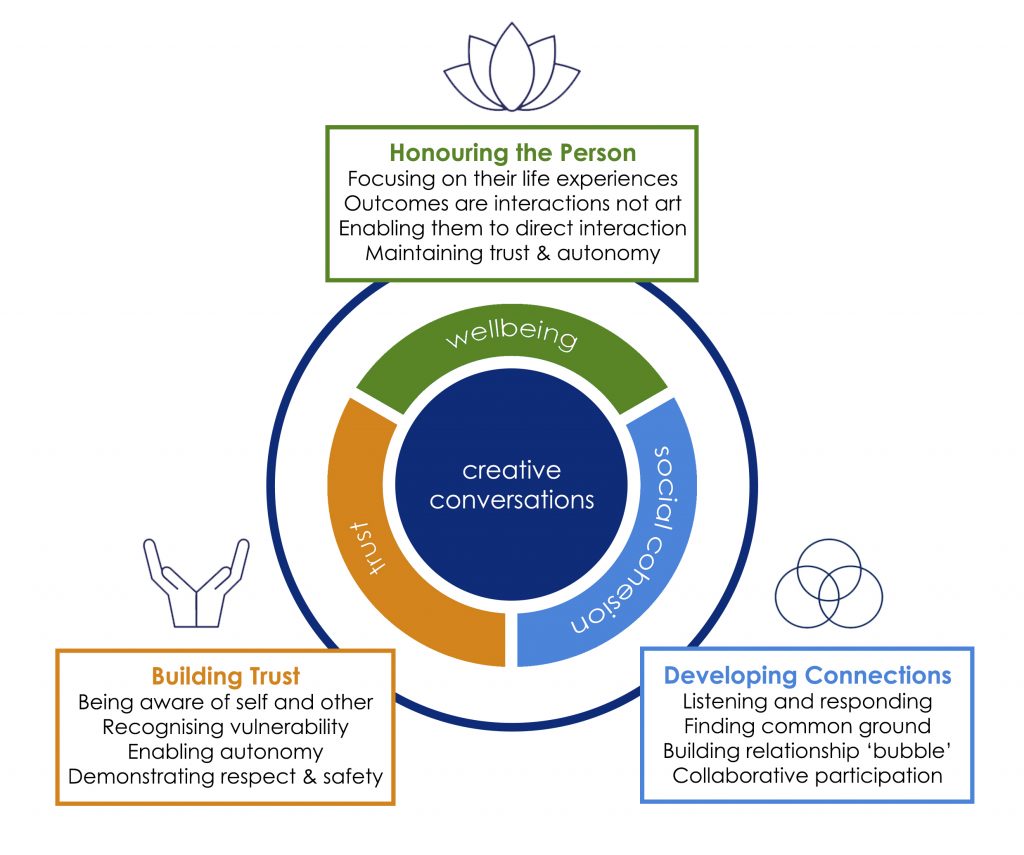
Each of the three key elements are outlined separately in order to explain what is at work, however in practice the creative practitioners apply these skills seamlessly throughout their interactions with patients.
Wellbeing – Honouring the Person
The theme of wellbeing was evident in the creative practitioners’ comments about honouring the person through:
- Focusing on the patient and their life prior to hospital and demonstrating it is valued
- Giving them any artwork for them to keep as it was produced to honour their life story, not to demonstrate the artist’s ability or to achieve project outputs
- Outcomes were often not the art
- Sensing when the person would be interested in taking part, or not, as well as sensing how much is enough
“We’re social engagement artists. We’re not sitting in our little studio. I think we have an innate curiosity about people. Certainly, I think you may be in your eighties or whatever, but that means you’ve had eighty plus years of living, of experience, and that’s really interesting.”
“In answer to the question of what is different that we bring to what a volunteer would bring in having those conversations is it sparks our imaginations. The difference is what we do with the information. They’ve shared information with us and it’s how we treat that and what we do with it.”
“There wasn’t much coming from her, but she was fully engaged. Her eyes were completely on mine. And that’s what I mean about the body language thing. It wasn’t polite eyes. It was a… no – please speak to me… eyes. This was when I was doing my poems, I want to find out a bit about the person so I can write a poem. So, I think I might have said to her, how long did you nurse for, and there was this silence and just the eyes. So, I rephrase the question… Have you been a nurse all your life? Nods. I realise I need to ask questions where she can nod as she’s struggling with the words. Then I thought what else can I ask about as she’s not able to talk. So, I thought I would drop a few obviouses and see if I get any nods or shakes. Like… oh that must have been very rewarding. Head nods. Then I was dropping in… did you like the so and so about it? Is this the difficult part? I’ve heard it’s really tiring… The only answers I was getting was the nodding. And then I said… what did I say… because it’s even how you say it… it’s really how you phrase it… I have to phrase it really carefully… so I’m not imposing. I’m not also ego-ing. Do you want something special of mine?… I’m not doing that. You’ve just got to phrase it really carefully. I’m just trying to… I think I said… I would like to write a poem, and I would like to write a poem about you. Is that OK? And then I tapped her out a tiny little poem on the
typewriter. I gave this to her, and she looks at it closely. And then we went to a couple of other people on the ward… and as we were leaving, she just came out of the bed and came over to me and grabbed my arm and just said… (whispers) thank you.”
Trust – Building and Maintaining
During the interactions and creative conversations, the creative practitioners were able to build and maintain trust with the patients by:
- Sensing the space, themselves and the other person
- Recognising vulnerability and the other person’s emotional state
- Offering the opportunity and establishing personal autonomy
- Demonstrating respect and safety (not forcing art on them, while also recognising and appreciating the fear of participating in art).
“Being adaptable and flexible I think is so important, because I think if you in with the mindset that you need to get this done, you’re going to fail. I had one lady who I was talking to, and we were having this great conversation going and she just went… “I don’t like any of that arty farty stuff”. I just went… Right, OK… We’re not going to do… We’re just going to have a conversation… That’s fine… And I think they get out as much out of having the conversation as they might do in an activity.”
“Yeah, and it’s not about you. So, you leave your ego at the door. And it’s as much about listening as talking and just picking up on the cues on what… both physically what people are doing, and it can be very, very subtle. But it’s still respecting that person’s world, that they are in. So, I don’t want them to think that they are being patronised in any way. And being talked down to. So, it’s just really honing, and tapping into where they are sitting in their little bubble on a ward. And just seeing how the Major can open a few doors. But I don’t go in sort of thinking… right, it’s performance time… Initially, for me it’s very much what the body language is. And the most obvious one will be if somebody is… and sitting in bed usually… and if they sort of like start pushing themselves back… Right, you’re a bit wary… that’s OK… So, the Major will keep his distance. He will still say hello. You know… Lovely to see you, darling… and everything like that. And gradually as that body becomes a bit more forward and then reading what their eyes are doing as well. And it’s quite often just that little inclination of the head to one side, kind of like… this is really weird… but I’m kind of drawn to him…”
“Yeah so, it’s much easier for us to enter into a person’s world with dementia than it is for them to enter into our world. But then it’s not just being able to enter it but to be able to join them and to be with them on that little creative journey of their own. And to go with them whatever way that might be. And that’s what I think the creative brain can do quite quickly. For me a lot of the stuff is around noticing. It’s noticing what’s above the bed, what they are allowed to eat, not eat or what they like to be called… It’s the noticing of details. Looking at what makes that person. Particularly with long stay patients where they have lost everything and they’re in a bed, in a bay, with bland colours and home is that little bed, chair, bedside table. The bed is their world and then we knock on that door… to make those connections.”
Social Cohesion – Developing Connections
The theme of social cohesion was evident through the creative practitioners’ comments about developing connections with the patients, which involved:
- Listening and responding creatively
- Finding common ground
- Building the “relationship bubble” and demonstrating the importance of this social relationship
- Collaborative participation
- Reducing loneliness.
“You have to be particularly sensitive to an environment and sensitive to people’s needs. And being able to read… either read the room, whether that’s the ward, or read that particular individual at a time. And don’t get me wrong, we don’t always get it right. But, just finding that initial way in. There’s that sense of anticipation, but then trusting yourself, as an artist, as a person, as a sensitive person who loves working with people and wants to get the best out of an individual. It’s kind of trusting yourself to then go into that environment and explore… experiment… play… create… all those different things. And I realised week by week it was the simple things that we did that actually made the biggest difference. So, it wasn’t necessarily coming armed with all sorts of activities… right, do you want to do this, do you want to do that… it was just something as small as putting a leaf on a tree. I remember there was one lady, and she had quite bad dementia… so, how you say a way in… well… I was pregnant at the time, and my way in, actually, to her was that I think she had four children. So, all of a sudden, she saw my bump, and that was kind of like… then it sparked off a little conversation and interaction. In terms of the art activity, I think we only went as far as… I had this colourful box, and I think she opened it, and it had some yarn hearts in it, but she didn’t want to touch them or take them out of the box. But she looked at this box and her eyes lit up. And to her, that was the engagement. That was enough. And then she told me all about the children that she’d had and how the girls were the worst… But it was such a small engagement on the face of it, but actually, a lot happened in those small moments. And maybe we only spent ten minutes together and didn’t exchange that many words… but it’s like the feeling… I often talk about the work that I do and it’s the feeling that you leave behind. So, whether that’s a feeling of contentment or… just making somebody smile. So simple, small little pieces of… fleeting moments… that’s what I keep coming back to. These fleeting moments. And those were the ones that made such a difference really.”
Working on the Wards
While there is a growing body of evidence demonstrating that arts in health activities can make a valuable contribution towards improved outcomes for patients, the interview data suggests that they can only be realised through good working relationships with ward staff. This includes:
– Developing trust
– Demonstrating respect for the day-to-day ward environment
– Working collaboratively to understand the needs of individual patients
– Maintaining continuous dialogue as to how activities are provided on the wards
Ward staff reported the most valuable aspect of the project was that the creative conversations provided an “access point” where the patients were more likely to talk about their lives and experiences. Staff reported that they were able to better understand and connect with their patients following the sessions, whether they were present or not.
“Initially, staff were terrified of The Major because they didn’t understand what he was. But over time The Major came in and started discussions with our patients that they wouldn’t have had with us. The Major was a very relatable character, and I think they could recognise parts of themselves within it.”
“They do a lot of reminiscence work, and it gives our patients a space to express their emotions. It helps them to develop a sense of identity as well. Within hospital what commonly happens is you become a patient and nothing else. The Healing Arts programme really helps us to delve into who these people are; better understand them, better prescribe care. It can make a massive difference to how they feel on a day-to-day basis without us having to go down the route of looking into medication for treatment of things like depression.”
“There was one particular gentleman who we thought was confused, turns out to be a mental health issue. He was quite challenging one-to-one, but I spent a really happy time drawing… So it’s the little things like that and I like to think it kept him settled for the rest of quite a busy weekend. But it was a very good reminder for everyone that actually he’s just struggling. And if we find a way to connect, it’s all going to be a lot more peaceful.”
Addressing Challenges
The two greatest challenges reported by ward staff were: reservations about anything creative and understanding the benefits. As part of the project, ward staff were offered dedicated workshops so that they could experience working with creative practitioners for themselves, as well as focusing on their own wellbeing and connecting as a team.
“It helps with better patient management, especially when a patient is in distress. You know, like it is really hard to manage someone with distress in that acute setting, especially with dementia. We’ve seen that it really benefits them.”
“It was really good fun actually. And it was nice working with the people from the other wards, like Elm C and seeing what they are doing. I was the only one who could make it from here. So it was nice to have that sort of little community.”
“The Healing Arts team started to work with a number of our healthcare assistants and our nurses on how to deliver this programme to better integrate that project within our ward. It’s been very beneficial, not just to give our patients better experiences, it’s also empowered our staff. And through that training we have actually accessed creative reflection and wellbeing support for all of our staff. We had away days and everyone had really low morale before that, and then we did some really good creative impact stuff and afterwards everyone’s morale has improved.”
Discussion and Recommendations
While the benefits of arts in health activities, such as those provided by the Unfold the Untold project, have been evidenced to make a valuable contribution to improved outcomes for patients, this evaluation demonstrates that they can only be realised through good working relationships with ward staff. This includes:
- developing trust
- demonstrating respect for the day-to-day ward environment
- working collaboratively to understand the needs of individual patients
- maintaining continuous dialogue as to how activities are provided on the wards
- responding to staff wellbeing needs
Buy-in from ward staff was reported to take a few months at least, and this is to be acknowledged and respected. Offering one off sessions on the ward and inviting ward staff to join dedicated staff wellbeing sessions have been successful to date in supporting engagement and understanding of the Healing Arts activities.
Future staff wellbeing sessions should be developed in line with feedback from staff surveys and direct discussions with ward staff. Promotion of Healing Arts activities throughout the Trust’s hospitals should also include opportunities for all staff to feedback with comments and suggestions for future activities.
References